How it all Began
For the love of oak
Border Oak was founded in Herefordshire in 1980 by brothers in law John Greene and Mark Hicks.
But in many ways the catalyst for their adventure began a lifetime before.
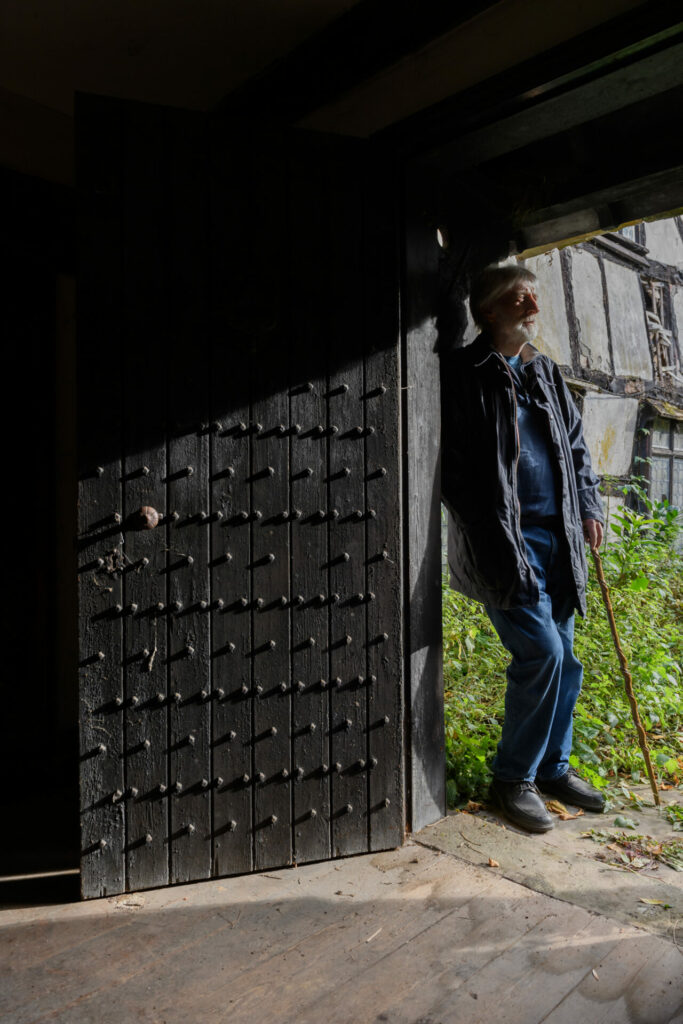
This is John standing in the door way of an incredible oak framed manor house that he had known and loved all his life – Staick House, Eardisland – and was a significant inspiration to him.
The other photos are of John and Mark in the early days of Border Oak.
As children John and his sisters lived in a number of old oak framed buildings, always under restoration of some sort inspired by the eccentric vision of their unconventional but highly talented father Reg.
John was surrounded by a dazzling variety of beautiful medieval oak buildings of the Welsh Marches – from barns to castles and every imaginable structure in between.
The romance and longevity of oak framing seeped into John’s soul and shaped his life.
A Rash Purchase
As an adult John tried many jobs – working in a bank, as a publican, as a surveyor and later thriving within engineering and construction. Yet he yearned to work for himself (or was he simply unemployable?) to be creative and achieve something unique – and to perhaps be a little disruptive. Architecture and housing were huge passions, as was craftsmanship, inventing and making.
In his early 30’s he was a director of steel agricultural framing company – originally employed accidentally as a surveyor, when really they needed a quantity surveyor (so he did both jobs). One day his visited a client near Hay on Wye only to discover an original 14th Century cruck frame barn on the site of the proposed new shed and just days from demolition.
John knew instantly that the barn was incredibly special and panic set in. He pleaded for alternative milking parlour locations but the farmer was steadfast – so John (a keen risk taker at heart) rashly offered to buy the barn (with money he didn’t yet have).
John then quickly coerced a few friends to dismantle the old frame, piece by piece & peg by peg, and transport the wooden bundle to John’s orchard 20 miles away. For a few years it sat in a pile under the apple blossom before John recruited his new brother in law (by chance a good carpenter) to help him turn his acorn of an idea into reality.

From Little Acorns…
John and Mark spent the next few years reerecting the oak barn in the orchard, making new frame parts where needed. They came to deeply regret not surveying the frame in the panic to move it, and not numbering each piece and its partner. However, later (and albeit begrudgingly) they agreed that fathoming out which bit of wood went where had proven to be an incredibly valuable mistake as they had had to wrestle the structure back in to life, learning much along the way.
John became more enamoured with the barn as they worked on it, marvelling at the engineering, resilience and craftsmanship with each passing month. As he lugged thousands of Herefordshire stone tiles up onto the new roof through both pouring rain and blazing sun, the idea of reviving the craft of green oak framing took root.
John’s dream of making new oak framed homes, reviving old skills after more than two centuries of dormancy, and creating an entirely new construction model (as an antidote to the suburban estates springing up in the 1970’s) seemed crazy, impossible and thrilling in equal parts.
…and a little bit of luck
Once the cruck barn frame was standing John, a skilled draughtsman, drew plans to convert the barn into his family home – a cheeky long shot but worth a try. He submitted his scheme to the District Council and awaited the Planning Officers visit and inevitable struggle.
However the young officer that arrived on site was cock a hoop that Mark and John had saved the barn. He could also see that it was a frame of National significance and admired the huge efforts taken to save it. In fact the officer deemed it so architecturally important that he felt he simply couldn’t allow it to be spoilt with modern luxuries such as kitchens and bathrooms!
After a long debate the officer proposed a compromise – and agreed that the required pipes and plumbing could potentially be contained within an extension to the side of the barn. This would leave the majestic frame as one large space, but enable John and his young family to live there.
The only condition was that the extension must be made of an authentic green oak framing to match the barn. John pointed out that no one made oak frames anymore and hadn’t for several centuries, but the officer rightly countered that John and Mark clearly now had all the skills and knowledge required to make the new frame themselves.
And so they did. You can see the new oak extension John designed and built here.
Before long other people came looking for the mad brothers who had revived the lost art of green oak framing – and Border Oak was born.